
"A holistic view of the universe, people, institutions and nature"
Biodiversity of Conscience: An Internal Framework Model for Ethical Pluralism in Higher Education
Published: June 2026 · Journal of Ethics in Higher Education, Vol. 8, Issue 2, pp. 149–185 · Conceptual Article
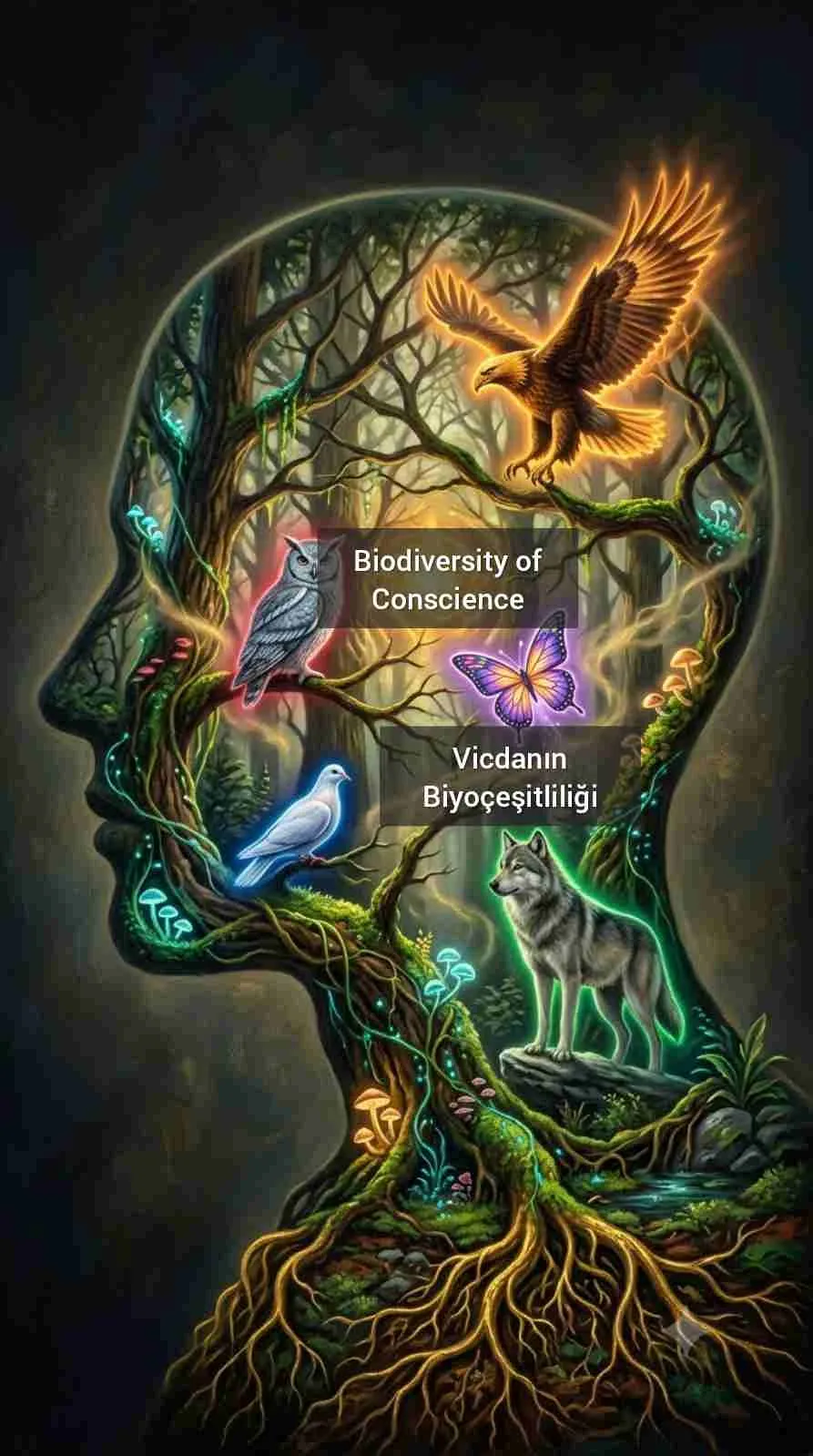
Imagine a rainforest where only a single species is allowed to grow. No undergrowth, no competing trees, no diversity of root systems. Such a forest would be fragile — one disease, one drought, and the whole thing collapses. Now imagine conscience organised the same way: one voice, one rule, one judge. That, this article argues, is the structure of ethical monoculture — and it is exactly what higher education must move beyond.
In my article published in the Journal of Ethics in Higher Education, I introduce the Internal Biodiversity Framework (IBF) — a conceptual model that reconceptualises conscience not as a single inner judge but as a living internal ecosystem of distinct ethical voices. Drawing on ecological biodiversity as a guiding metaphor, the framework synthesises insights from psychodynamic theory, moral psychology, neurobiology, and philosophical traditions ranging from Nietzsche and Hartmann to Confucian ethics and Ibn Miskawayh.
Core ecological concepts structuring the IBF: species diversity, habitat, ecological niche, symbiosis, endemism, succession, ethical resilience, and consilience.
Field-tested pedagogical tools introduced: the Ethical Voice Diary, the Ethical Ecosystem Map, and the Orchestra Conductor Protocol.
Scope of the article (pp. 149–185), covering philosophical foundations, functional benefits, threats, applications and a future research agenda with draft hypotheses.
Internal Biodiversity Framework — a principled, pluralistic approach to ethics education that resists both moral relativism and ethical monoculture.
The central question the article addresses is one every higher education institution faces: how can universities cultivate graduates who are morally resilient and ethically agile in the face of growing value pluralism? The answer the IBF proposes is counterintuitive — not by giving students a single authoritative ethical framework, but by helping them recognise, cultivate, and coordinate the multiple ethical voices they already carry.
Each voice — compassion, justice, loyalty, freedom, sanctity, social interest — occupies an ecological niche. Each becomes active in its appropriate context (habitat). When voices cooperate productively, they generate consilience: responses wiser than any single voice could produce alone. When one voice dominates all others, ethical monoculture sets in — and with it, fragility, burnout, and what the article terms the ethical nocebo effect: the self-fulfilling paralysis of a conscience that believes moral action is impossible.
The IBF also proposes concrete tools for higher education pedagogy: the Ethical Voice Diary (a structured daily reflection tracking which voices were dominant or suppressed), the Ethical Ecosystem Map (a visual representation of a student's inner moral landscape), and the Orchestra Conductor Protocol (a decision-making discipline for academic leaders that structurally prevents single-voice reasoning). An eight-week implementation programme outlines how these tools can be integrated into existing ethics courses or leadership development seminars.
Critically, the framework does not slide into relativism. Like every ecosystem, the internal ecosystem of conscience has keystone species — ethical voices whose removal triggers collapse. Respect for human dignity and the prohibition on treating persons merely as means are not preferences to be balanced away; they are the foundational constraints within which ethical diversity flourishes.
📄 Access the Full Article
Çetin, A. (2026). Biodiversity of Conscience: An Internal Framework Model for Ethical Pluralism in Higher Education. Journal of Ethics in Higher Education, 8(2), 149–185.
Conceptual Article · DOI: https://doi.org/10.26034/fr.jehe.2026.9780
This page is a summary of the author's peer-reviewed article (published in English). The full Turkish text and the original article are available via the links above.

Independent researcher and educator working at the intersection of ecology, ethics, and education. Originator of the Internal Biodiversity Framework (IBF) and the Botanical Coaching approach.
About me →📌 How to cite this article:
Çetin, A. (2026). Biodiversity of Conscience: An Internal Framework Model for Ethical Pluralism in Higher Education. Journal of Ethics in Higher Education, 8(2), 149–185. https://doi.org/10.26034/fr.jehe.2026.9780
📚 More from Abdullah Çetin: